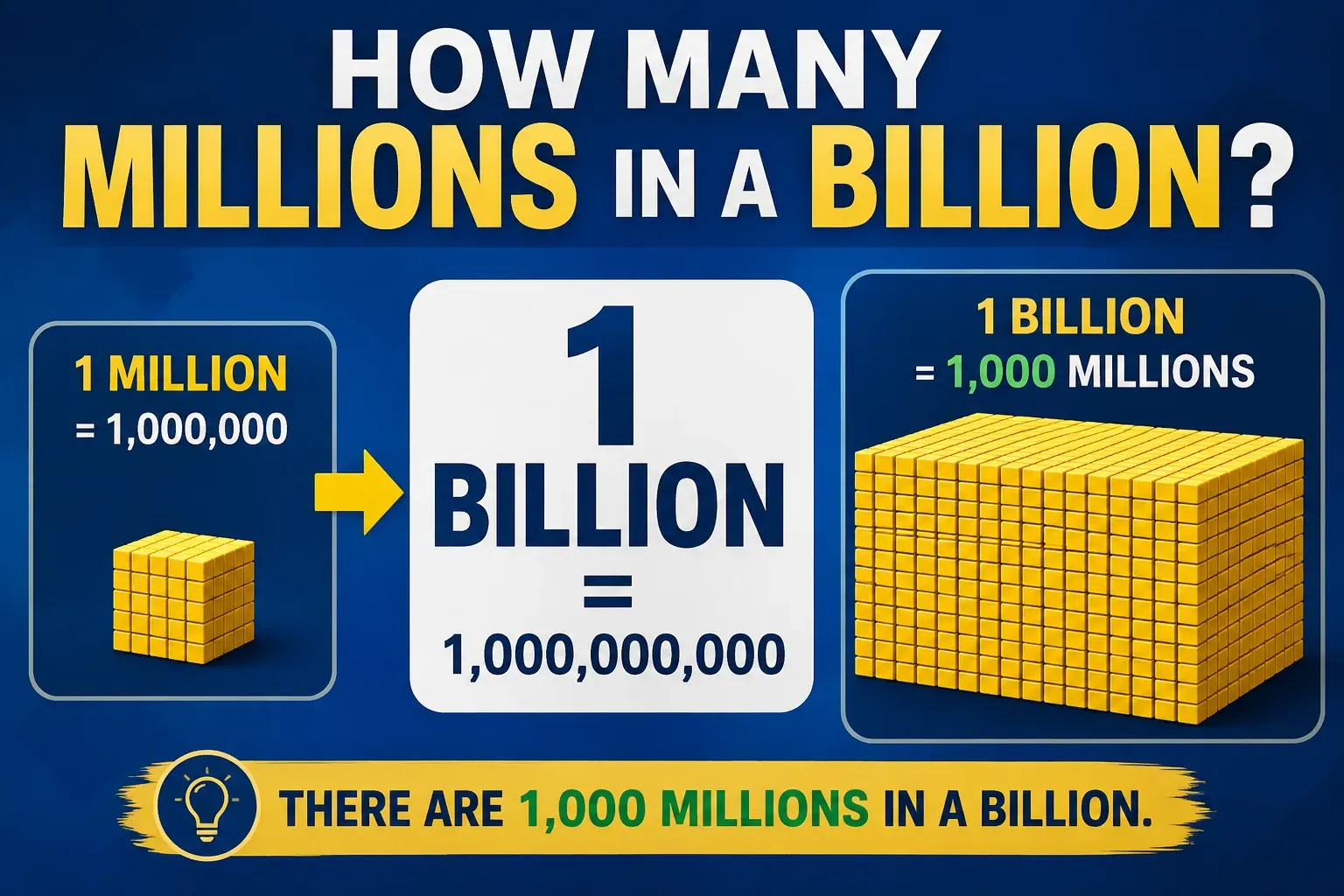
How Many Millions in a Billion? The Quick Answer and Its Impact
Introduction
Have you ever found yourself staring at a headline about government spending or a company’s market value and wondered, “Exactly how many millions in a billion?” It’s a common question. The short, powerful answer is one thousand. A billion is equal to 1,000 million. This seemingly simple conversion is the key to unlocking a true understanding of the vast scale of big numbers .
How Many Millions in a Billion? The Core Answer
The direct answer to the question “how many millions in a billion” is 1,000. This means one billion is one thousand times larger than one million. This relationship is the foundation for understanding the scale of billions, trillions, and beyond in our modern world.
Visualizing the Difference: A Simple Table
To make the “how many millions in a billion” concept crystal clear, refer to this table. It breaks down the number of zeroes and the relationship between these critical large numbers.
| Number | Value | Number of Zeros | How Many Millions? |
|---|---|---|---|
| Million | 1,000,000 | 6 | 1 |
| Billion | 1,000,000,000 | 9 | 1,000 |
| Trillion | 1,000,000,000,000 | 12 | 1,000,000 |
As the table shows, one billion is essentially a thousand million.
Understanding the US and UK Billion: A Brief History
The concept of a billion has a history that can cause confusion. Historically, the UK used a “long scale” where a billion meant a million million (1,000,000,000,000) . The US, however, used the “short scale” where a billion meant a thousand million (1,000,000,000).
In 1974, the UK government officially adopted the US definition to align with international usage, especially in finance and science . So, today, when you ask “how many millions in a billion?”, the internationally accepted answer is 1,000. While the older British billion definition might appear in historical texts or older literature, its use is now very rare .
The Math Behind the Number: A Step-by-Step Guide
Understanding the math is simple. To find out how many millions in a billion, you just divide a billion by a million:
1,000,000,000 / 1,000,000 = 1,000
The division of 1 billion by 1 million gives us 1,000 . This demonstrates that a billion is precisely 1,000 million.
Converting Millions to Billions and Vice Versa
Now you understand the relationship, here’s how to convert between them:
- To convert millions to billions: Divide the number of millions by 1,000.
- Example: 5,000 million / 1,000 = 5 billion.
- To convert billions to millions: Multiply the number of billions by 1,000.
- Example: 3.5 billion * 1,000 = 3,500 million.
Practical Examples and Real-World Applications
Let’s make the question “how many millions in a billion” more real with examples. When a company reports a profit of $2 billion, it means a profit of 2,000 million dollars. If a country has a population of 1.4 billion, it has 1,400 million people.
From a Billion to a Trillion: Scaling Up Even Further
Once you have grasped the concept of “how many millions in a billion?”, the next logical step is to understand a trillion. There are 1,000 billion in a trillion, which means a trillion is equal to one million million .
- 1 trillion = 1,000 billion
- 1 trillion = 1,000,000 million
The Power of Ten: Scientific Notation and Large Numbers
For scientists and mathematicians, these numbers are often written in scientific notation. This makes working with them much easier.
- Million = 10^6
- Billion = 10^9
- Trillion = 10^12
This shows that a billion is three orders of magnitude larger than a million, representing a tenfold increase for every set of three zeros .
Global Perspectives: How “Billion” is Used Worldwide
The question “how many millions in a billion?” can be answered differently in some parts of the world. While English-speaking countries use the short scale (1 billion = 1,000 million), many European and Latin American languages, like Spanish and French, use a word similar to “billion” (e.g., billón) to mean a million million (1,000,000,000,000) . In these countries, the number 1,000,000,000 is often called “one thousand million” (mil millones in Spanish) or a “milliard.” Understanding this distinction is important for global data interpretation .
The Real-World Impact: Why This Distinction Matters
Understanding the answer to “how many millions in a billion” is more than just a trivia fact. It is essential for financial literacy, comprehending news, making informed decisions, and communicating effectively in business and science. A billion is not just a large number; it’s a number with significant weight and meaning.
FAQs
1. How many millions are in a billion?
There are 1,000 million in one billion. The relationship is 1 billion = 1,000 million.
2. Is a billion the same in the UK and the US?
Yes. The UK officially adopted the US definition of a billion as 1,000 million in 1974 to avoid confusion in international finance and scientific reporting.
3. How many billions are in a trillion?
There are 1,000 billion in one trillion. Therefore, 1 trillion is equal to 1,000,000 million.
4. What is the formula to convert millions to billions?
To convert millions to billions, simply divide the number of millions by 1,000 (e.g., 50 million / 1,000 = 0.05 billion).
5. What is the formula to convert billions to millions?
To convert billions to millions, multiply the number of billions by 1,000 (e.g., 4.5 billion * 1,000 = 4,500 million).
6. How many zeros are in a million, billion, and trillion?
One million has six zeros (1,000,000), one billion has nine zeros (1,000,000,000), and one trillion has twelve zeros (1,000,000,000,000).
Conclusion: Mastering the Scale of Large Numbers
Knowing the answer to the question “how many millions in a billion?” is fundamental for anyone looking to confidently navigate the world of big numbers. With 1,000 million making up a single billion, you now have the tools to understand these vast figures. This knowledge makes financial news, scientific data, and global statistics far more accessible and understandable.