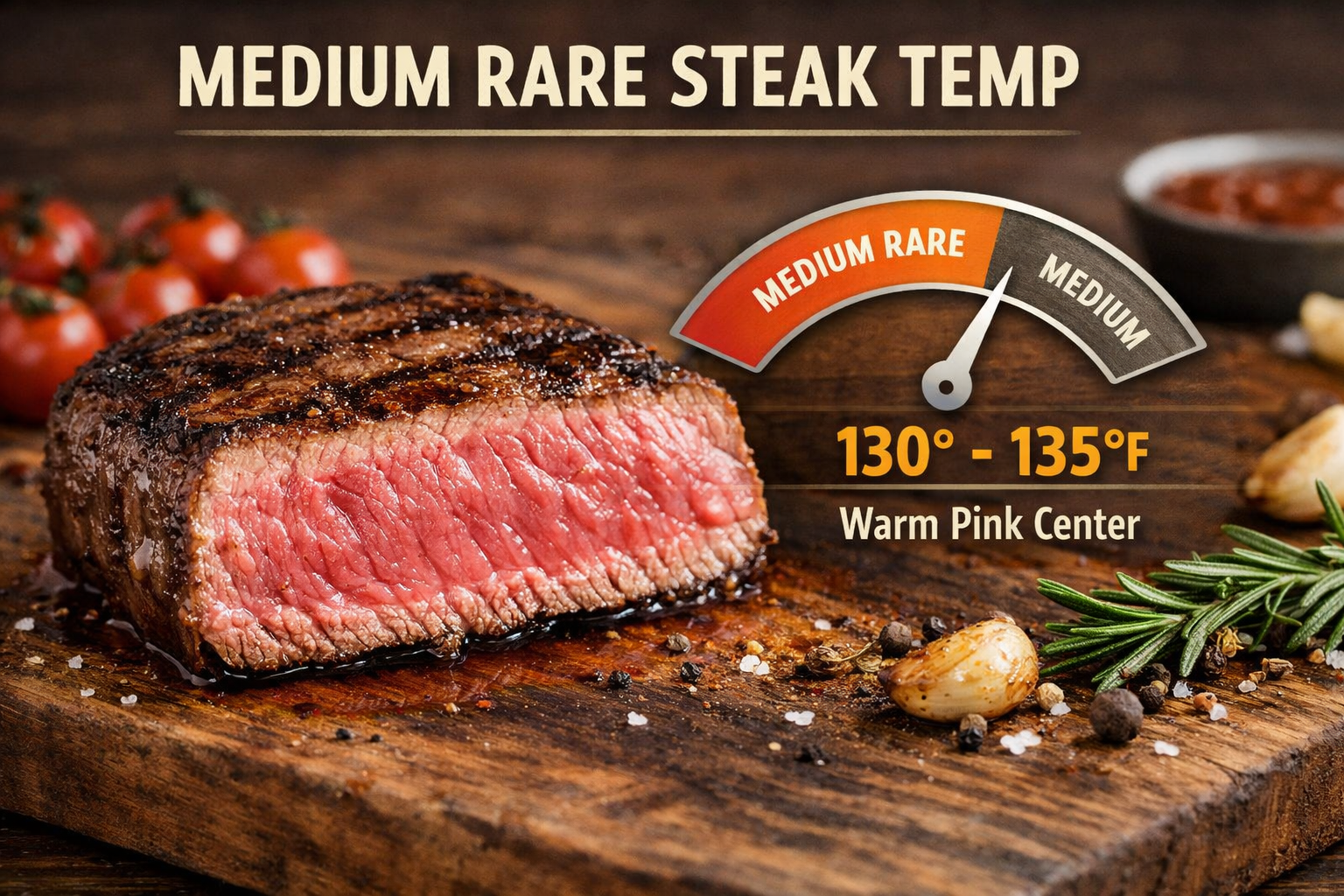
Medium Rare Steak Temp
Introduction
Let me tell you about the best steak I ever made. It was a Tuesday night. Nothing special. Just me, a cast-iron skillet, and a beautiful ribeye. I pulled it off the heat, let it rest, and sliced into it. The color? Perfect warm red. The texture? Like butter. The juice? It didn’t run all over the plate—it stayed right inside the meat where it belonged.
That is the magic of the medium rare steak temp.
If you have ever cut into a steak only to find it gray and dry—or worse, still mooing at you—you are not alone. Most home cooks struggle with doneness. But here is the truth: cooking the perfect medium rare steak is not about luck. It is not about talent. It is about one simple thing: temperature.
Today, I am going to teach you exactly how to hit that sweet spot. No fancy chef training required. Just a thermometer, a little patience, and this guide.
What Exactly is the Medium Rare Steak Temp?
Let’s get right to the point. The medium rare steak temp is 130°F to 135°F .
When your steak hits this range, something magical happens. The fat has rendered just enough to taste sweet and buttery. The proteins have tightened up but not squeezed out all the moisture. The center is warm, not cold. And that famous pink color? It runs from edge to edge like a beautiful sunset .
I want you to remember this number. Write it on a sticky note for your fridge. 130 to 135. This is your target.
Now, here is a pro tip that most people do not know: you should actually pull your steak off the heat at about 128°F or 130°F. Why? Because your steak keeps cooking even after it leaves the pan. This is called carryover cooking, and it is the secret weapon of every great steakhouse chef .
Why Medium Rare is the Gold Standard
Have you ever wondered why chefs get so excited about medium rare steak? It is not snobbery. It is science.
When beef cooks, the muscle fibers tighten up like a fist. At lower temperatures, that fist is relaxed. It holds onto water and flavor. But as the temperature climbs, that fist clenches tighter and tighter. Eventually, it squeezes all the juice right out .
At medium rare temp, the fat has melted into the meat but the moisture is still locked in. You get the best of both worlds: rich, beefy flavor and a texture that practically melts on your tongue.
I have eaten steak at every level of doneness. I have had well-done hockey pucks at backyard cookouts. I have had blue-rare steaks that were still cold in the middle. But medium rare? It never disappoints. It is the perfect balance .
🥩 THE ULTIMATE STEAK DONENESS TABLE
⚡ every temp, every cut, every secret – 3D neon edition
| Doneness Level | Internal Temp | Visual & Center Color | Texture & Mouthfeel | Juice Retention | Best Cuts for This Level | Best Cooking Method | Pull Temp (Carryover) | Rest Time | Flavor Notes | Common Mistakes |
|---|---|---|---|---|---|---|---|---|---|---|
| Blue (Very Rare) | 110–119°F (43–48°C) | Deep red, nearly raw center; cool to touch | Very soft, spongy, almost raw; zero chew | Extremely high | Filet mignon, tenderloin | Ultra‑hot sear only (60 sec per side max) | Pull at 105–110°F | 3–5 min | Pure, metallic, raw beef; fat not rendered | Not resting enough; using tough cuts |
| Rare | 120–129°F (49–54°C) | Bright red center, warm but not hot; slight gradient | Tender, juicy, light resistance; silky | Very high | Filet, ribeye, strip loin | High‑heat sear + short oven finish; reverse sear works | Pull at 115–118°F | 5 min | Clean beef taste; fat barely melted | Pulling too late; skipping rest |
| 🔥 MEDIUM RARE | 130–135°F (54–57°C) | Warm red center, vivid pink; edge‑to‑edge color | Buttery, tender, perfect bite; fat fully rendered | Optimal balance—juicy but not wet | Ribeye, NY strip, porterhouse, sirloin | Reverse sear, sous vide, cast‑iron sear + oven | Pull at 125–128°F | 5–8 min | Rich, beefy, sweet from rendered fat | Cutting too soon; pan not hot enough |
| Medium | 135–145°F (57–63°C) | Hot pink center, narrowing band; mostly opaque | Firmer, noticeable resistance; less juicy | Moderate | Strip, flank steak, tri‑tip, burgers | Grill, pan‑sear, broil | Pull at 130–135°F | 5–7 min | Balanced; fat melted, slight caramelization | Overcooking by just 2–3 degrees |
| Medium Well | 145–155°F (63–68°C) | Slight pink sliver, mostly brown; narrow band | Quite firm, chewy; dry edges | Low | Only fatty cuts like ribeye can survive | Slow grilling or braising | Pull at 140–145°F | 5 min | Faint beef taste; mainly salt and char | Cooking premium cuts this way; no pink left |
| Well Done | 155°F+ (68°C+) | Brown throughout; no pink, possibly gray | Tough, fibrous, crumbly; leathery crust | Very low | Only brisket, chuck (braised, not grilled) | Braising, stewing, low‑and‑slow smoking | Pull at 150°F+ | 3–5 min | Caramelized crust, little beef flavor | Ruining expensive steaks; skipping thermometer |
Notice how medium steak temp runs from 135°F to 145°F. That is a wider range than medium rare. But here is the catch: once you pass 135°F, you are losing moisture by the second .
If you prefer medium well steak (145-155°F), you will still get a hint of pink. But the texture will be noticeably firmer. And well done? Let us just say the cows prefer you not to go there .
The Number One Mistake: Cooking By Color
I need to tell you something important. You cannot trust your eyes.
I learned this the hard way. For years, I thought I could “just tell” when a steak was done. Sometimes I was right. Sometimes I served a room-temperature brick to my dinner guests.
Here is the truth: color lies. A steak can look perfectly pink on the outside while the center is still raw. Or it can look gray and dead while the inside is actually medium rare .
Why? Because myoglobin (that red protein in meat) behaves differently depending on the meat’s age, the animal’s diet, and even how the steak was packaged at the store .
The only way to know for sure? A good instant-read thermometer. Stick it through the side of the steak into the very center. Avoid bone and fat. Read the number. That is your truth .
Carryover Cooking: The Secret Weapon
Let me teach you a word that will change your steak game forever: carryover.
When you take a hot steak off the grill or out of the pan, the heat from the outside continues traveling inward. Your steak does not stop cooking just because you moved it to a plate .
For a normal 1-inch thick steak, the temperature will rise about 3°F to 5°F while it rests. For a thick tomahawk or porterhouse? It can climb 10°F or more .
So if you want your final medium rare steak temp to be 130°F, you need to pull that steak at 125°F or 127°F. Let it rest. Watch the thermometer climb. Then slice.
This single tip separates nervous home cooks from confident grill masters. Trust the carryover.
How to Get That Perfect Crust Without Overcooking
Here is the challenge we all face. You want a dark, crispy, flavorful crust. But you do not want to turn your beautiful medium rare steak into a well-done accident.
The solution? Reverse sear.
I discovered this method about five years ago, and I have never looked back. Here is how it works:
First, cook your steak low and slow. Put it in a 225°F oven or on the cool side of the grill. Let it gently come up to about 115°F or 120°F. This takes time—maybe 30 to 45 minutes—but patience pays off .
Then, and only then, do you hit it with high heat. A screaming hot cast iron pan. A blazing grill. 60 to 90 seconds per side. You will get a crust so dark and flavorful it looks like it came from a thousand-dollar steakhouse.
But the inside? Still perfect medium rare. Because you only applied intense heat to the outside for a very short time.
This method changed my life. It will change yours too.
Which Cuts Work Best for Medium Rare?
Not all steaks are created equal. Some cuts absolutely shine at medium rare temp. Others… well, they need more help.
Best cuts for medium rare:
- Ribeye: All that marbling melts into butter at 130°F. This is my personal favorite .
- Filet Mignon: Lean and tender. Medium rare keeps it from drying out.
- New York Strip: Firm texture, big beef flavor. Perfect at medium rare.
- Porterhouse/T-Bone: You get two textures in one steak. A gift from the beef gods .
Cuts that need more time:
- Chuck: Tough and full of collagen. This needs low-and-slow braising or 30+ hours in a sous vide bath .
- Brisket: Forget steak. Smoke this low and slow until it pulls apart.
- Round cuts: Lean and tough. Better for stew than the grill.
One reader told me he cooks chuck roast at 134°F for 40 hours, then sears it. He says it tastes just like prime rib. I tried it. He is right .
That Red Liquid Is Not Blood
Can we clear something up? Please?
The red juice on your plate is not blood. I promise you this.
Beef is drained of blood during processing. What you see is myoglobin—a protein that stores oxygen in muscle tissue. Mixed with water. That is it .
If you avoid medium rare steak because the pink color bothers you, I understand. We all have our preferences. My own mother orders her steak “so well done the cow should be refunded.” I love her anyway.
But know this: that pink juice is pure flavor. It is moisture. It is the reason medium rare temp tastes better than any other doneness.
If you prefer medium well steak or beyond, that is your choice. Just know what you are giving up .
The Sous Vide Shortcut
I need to tell you about my favorite kitchen toy.
Sous vide sounds fancy, but it is actually the laziest way to cook steak. You season the meat. You seal it in a bag. You drop it in water that is held at exactly the temperature you want. Then you walk away.
Want medium rare steak temp? Set the water to 130°F. Come back in an hour (or three). The steak cannot overcook. It cannot undercook. It just sits there, waiting for you .
Then you open the bag, dry the steak thoroughly, and sear it for 45 seconds per side. That is it.
The first time I did this, I actually laughed. It felt like cheating. But here is the thing: the steak was perfect. Edge to edge pink. No gray band. No guesswork.
If you struggle with carryover cooking, if you panic every time you flip a steak, sous vide is your answer .
How to Rest Your Steak (And Why It Matters)
You have cooked your steak to exactly 130°F. It looks beautiful. You want to eat it right now.
Stop. Wait.
If you cut into that steak immediately, all those juices you worked so hard to protect will flood out onto the cutting board. Not into your mouth. Onto the board.
Resting is not optional. It is essential.
Five minutes for a thin steak. Ten minutes for a thick one. Fifteen for a massive tomahawk. Tent it loosely with foil if you are worried about it getting cold .
During this rest, the temperature evens out. The juices redistribute. The muscle fibers relax.
Then you cut. And the juice stays in the meat, not on the plate.
This is the sign of a patient cook. Be that cook.
Frequently Asked Questions
Is 130°F safe for medium rare steak?
Yes. Whole cuts of beef are dense enough that bacteria stays on the surface. As long as the outside reaches a high temperature (which it will during searing), the inside is safe at 130°F. Ground beef is different—always cook burgers to 160°F .
Can I cook medium rare steak in a regular pan?
Absolutely. Cast iron is best, but any heavy-bottomed skillet works. Get it hot. Add oil with a high smoke point. Sear undisturbed. Add butter, garlic, and thyme at the end. Baste. Perfection .
What is the difference between medium rare and medium steak temp?
About 5 to 10 degrees. Medium rare is 130-135°F with a warm red center. Medium steak temp is 135-145°F with a hot pink center. Medium is slightly firmer and slightly drier .
Do I need a expensive thermometer?
You need an accurate thermometer. It does not have to be expensive. A $20 instant-read model is infinitely better than guessing. I use a Thermapen because I cook a lot of steak, but start with whatever you can afford .
What about over medium eggs?
Great question! Over medium eggs have a yolk that is partially cooked—jammy, not runny. This is different from steak, but the principle is similar: temperature matters. Eggs are safe at 160°F .
Why does my steak come out gray on the outside and raw inside?
Your pan is not hot enough. You are cooking the steak slowly, which drives heat deep into the meat before the surface can brown. Turn up the heat. Dry the steak thoroughly. Do not crowd the pan .
Conclusion: You Can Do This
I remember standing over my grill five years ago, holding a thermometer like it was a foreign object. I was nervous. What if I poked the steak and all the juice ran out? (Spoiler: it does not. That is a myth .)
But I took the temperature anyway. 128°F. I pulled the steak. I let it rest. I sliced it open.
And there it was. Perfect pink. Warm red center. Juice locked inside.
That night, I stopped guessing. I started knowing.
You can do this too. You do not need a culinary degree. You do not need a fancy grill. You just need to know the number—130°F to 135°F—and a tool to measure it.
The perfect medium rare steak temp is not a secret. It is not reserved for professional chefs. It is a simple, repeatable fact.
Now go cook that steak. Your best one yet is waiting.
🔥 You may also like to read about: Google DreidelAbout the Author
