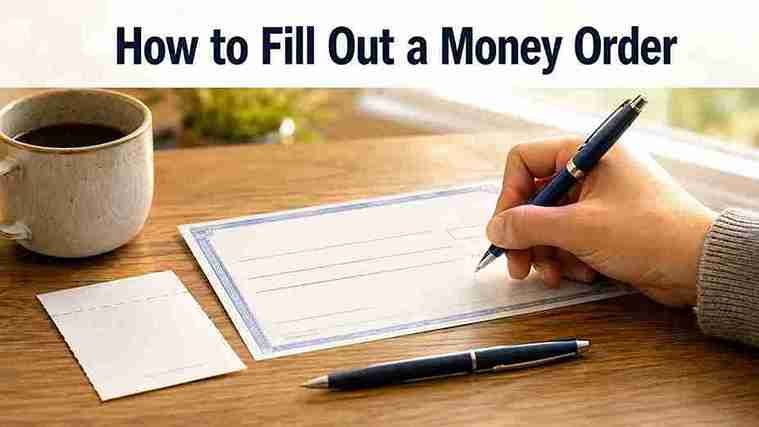
How to Fill Out a Money Order Correctly (Step by Step)
Filling out a money order seems how to fill out a money order confusing with multiple fields. A single mistake could delay payment or even void the money order. You risk losing money and time. This guide breaks down every field clearly so you can complete your money order in minutes, avoiding costly errors and ensuring your payment reaches its destination securely.
Money orders remain one of the safest ways to send guaranteed funds, especially when you don’t have a checking account or need a traceable payment method. But a surprising number of money orders get rejected because of simple filling errors. You don’t need a banking degree—just a pen, the right details, and clear instructions. This pillar page serves as your complete resource, covering every money order field, where to buy, fees, how to correct mistakes, and more. Bookmark it as your go-to money order walkthrough.
What Is a Money Order and Why Use It?
A money order is a prepaid paper payment certificate issued by a trusted third party like the U.S. Postal Service, Western Union, or MoneyGram. You pay the issuer the face value plus a small fee, and they print a document that guarantees the funds to the recipient. Unlike a personal check, the money order doesn’t bounce because it’s already paid for.
People use money orders when a payee demands guaranteed funds, when privacy matters (no bank account numbers shared), or when sending money through the mail feels risky. They’re also a staple for paying rent, buying from a private seller, or mailing a payment abroad.
Where to Buy a Money Order (and What You’ll Need)
You can purchase a money order at thousands of locations. Walk into a post office, a grocery store customer service desk, a convenience store, a check-cashing outlet, or a bank/credit union. Each issuer sets its own rules, but here’s what you typically need:
- Government-issued photo ID (driver’s license, passport, state ID)
- Cash or a debit card (most issuers don’t accept credit cards for money orders)
- The exact recipient name and your own address
- Enough funds to cover the money order amount plus the fee
Popular issuers include USPS (postal money orders), Western Union, and MoneyGram. Each has slight variations in the form layout, but the fields are nearly identical.
Parts of a Money Order: A Quick Visual Breakdown
Before you write anything, scan your money order to find the key sections. Most money orders carry these fields:
| Field | What It Does |
|---|---|
| Pay to the Order of | The person or business that will cash or deposit the money order. |
| Purchaser’s Address | Your mailing address so the recipient knows who sent it. |
| Purchaser’s Signature | Your signature (not the recipient’s) to authorize the payment. |
| Money Order Amount (Dollars) | Numeric box showing the total dollar amount. |
| Amount in Words | The amount spelled out completely. |
| Memo / Account Number | Optional line for a note, such as an account or order number. |
| Issuer / Serial Number | Preprinted tracking number and issuer logo. |
| Receipt / Stub | Detachable portion you keep for tracking and records. |
Keep the receipt attached until you’re ready to tear it off. It holds the serial number and tracking details.
How to Fill Out a Money Order Step by Step
This section answers the exact question “how to fill out a money order” with a field-by-field breakdown. Grab a blue or black pen. Pencil or gel ink that can smudge invites rejection.
- Write the recipient’s name on the “Pay to the Order of” line.
Print the full legal name of the person or the exact business name. If you’re paying a landlord, use the name written on your lease. Never leave this line blank—a blank payee line turns the money order into cash that anyone can use. - Fill in your address in the “Purchaser’s Address” section.
Some money orders label this “Sender,” “Remitter,” or “From.” Use your current mailing address. The recipient needs it to contact you or verify who sent the payment. - Add a memo if needed.
Use the “Memo,” “For,” or “Account Number” line to print a note—your rent unit number, invoice ID, or order number. This helps the recipient apply the payment correctly without delaying processing. - Sign the front as the purchaser.
Sign on the “Purchaser’s Signature” line. Do not sign the back; the recipient endorses the back when cashing it. A missing signature can stop the money order from being processed. - Enter the dollar amount in the box.
Write the amount clearly in numbers, starting close to the dollar sign to prevent tampering. Example: $150.75. - Spell out the amount on the “Amount in Words” line.
Write the dollar amount in words and the cents as a fraction. For $150.75, write “One hundred fifty and 75/100.” Draw a line through any unused space to block alterations. - Detach and keep the receipt stub.
The receipt contains the money order serial number. Use it to track delivery, confirm cashing, or request a replacement if the money order gets lost.
Double-check every field before you hand over the money order and your cash. Once the issuer stamps it, changes become difficult or impossible.
Source: USPS Money Order Instructions (link), Western Union How to Fill Out a Money Order (link)
How to Fill Out a Money Order Payable to a Business
When you fill out a money order to a company, use the business’s exact legal name—not a trade nickname. Check your bill or invoice for the “Payable to” line. For example, write “ABC Property Management LLC,” not “ABC Apartments.” List the account number in the memo field. A clear memo prevents delays where the business credits the wrong account. These small steps protect you from late fees and administrative headaches.
How to Fill Out a Money Order for Rent or a Landlord
Landlords often require money orders because they guarantee funds. Fill out the “Pay to the Order of” with the name registered on your lease. In the memo line, print your rental unit number and the month the payment covers (e.g., “Unit 4B – August 2026 Rent”). Take a photo of the completed money order and the receipt together before mailing or dropping it off. This creates a digital paper trail if a dispute arises.
Money Order Fees and Limits: What to Expect
Fees vary by issuer and purchase location. Expect to pay:
- USPS: $1.75 for amounts up to $500, $2.40 for $500.01–$1,000. International money orders cost more.
- Western Union: Typically around $1.50–$2.00 per money order, with a $1,000 max.
- MoneyGram: Fees hover near $1.50, also capped at $1,000 per money order.
Many stores set a maximum dollar limit of $1,000 per money order. If you need to send more, buy multiple money orders and fill out each separately. Government-issued photo ID is required for purchases over $3,000 due to federal reporting rules.
How to Correct a Mistake on a Money Order
Mistakes happen, but correction options are narrow. If you write the wrong name or amount, do not cross it out or use correction fluid. Most issuers will not accept an altered document. You typically must void the money order and buy a new one. Some locations let you void on the spot if the money order hasn’t left the counter yet. If you already walked away, you may need to go through a formal refund or replacement process, which often involves submitting a tracing request and a processing fee. Always start a new money order when errors occur.
How to Track and Cash a Money Order Safely
Use the receipt stub serial number to track a USPS money order on their website, or call the issuer’s automated line for Western Union or MoneyGram. This tells you if the money order has been cashed. If it gets lost, you can file a claim to request a replacement. For cashing, the recipient endorses the back and presents it at their bank, a check-cashing store, or the issuing location. Encourage the recipient to cash it promptly—stale money orders can be subject to escheatment laws if held too long.
Money Order vs. Cashier’s Check vs. Personal Check
- Money Order: Prepaid, maximum around $1,000, widely available, no bank account needed.
- Cashier’s Check: Issued by a bank, larger amounts allowed, higher fees, requires a bank account.
- Personal Check: Funds drawn from your account, can bounce, reveals your account and routing numbers.
Choose a money order when you need a low-cost, anonymous, and guaranteed payment under $1,000 without involving your bank.
Common Money Order Scams to Avoid
Scammers love money orders because they feel like cash. Never accept a money order for more than the asking price and wire back the difference—that’s a classic overpayment scam. Verify funds with the issuer directly if you receive a money order from a stranger. Look for security features like watermarks and a heat-sensitive patch. Genuine USPS money orders show a Benjamin Franklin watermark and a visible security thread. The Consumer Financial Protection Bureau warns that fake money orders can take weeks to bounce after a bank initially accepts them. Protect yourself by only dealing with trusted parties.
Frequently Asked Questions About Filling Out Money Orders
Can I use a pencil to fill out a money order?
No. Always use a blue or black pen. Pencil can be erased, and gel ink smears, raising rejection risks.
What happens if I make a mistake while filling out a money order?
You usually must void it and buy a new one. Alterations, cross-outs, or correction fluid void the document.
How do I fill out a money order payable to myself?
Write your own legal name on the “Pay to the Order of” line. Then you can sign the front as purchaser and later endorse the back to cash it.
Do I need to sign the back of a money order I’m sending?
No. Only the recipient signs the back. You sign the front as the purchaser.
Can I fill out a money order online and print it at home?
A few digital services allow this, but standard USPS, Western Union, and MoneyGram money orders require in-person purchase and completion. Always check the issuer’s current options.
Where do I write my address on a money order?
Look for the “Purchaser’s Address,” “Sender,” or “Remitter” field—usually near the top or left side. If there’s no dedicated box, your address is still required somewhere on the front for the money order to be valid.
You now know exactly how to fill out a money order without second-guessing. Keep this page bookmarked as your quick-reference guide. Ready to send your payment? Head to your nearest post office, grocery store, or credit union with your cash, the recipient’s details, and this checklist in hand. Found this helpful? Share it with a friend who’s mailing a rent check or sending a secure payment for the first time. For more step-by-step money tools, explore our payment safety hub.
About the Author: This guide was produced by a team of personal finance experts and fact-checked against current USPS, Western Union, and MoneyGram guidelines. All steps reflect official issuer requirements and consumer protection best practices.